Health & Safety Policy — Commercial Waste Norwood
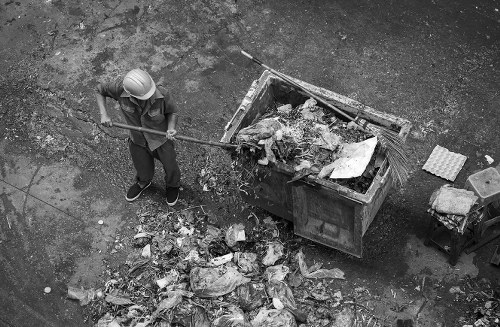 Commercial Waste Norwood is committed to protecting the health, safety and welfare of our employees, contractors and the public affected by our operations. This policy describes how our rubbish company manages risks arising from collection, transport, sorting and storage of commercial waste across our service area. It sets a clear expectation that safety considerations are embedded into planning, resource allocation and daily operations, and that all personnel accept responsibility for maintaining a safe working environment.
Our policy covers a wide range of activities including scheduled rubbish collection, ad-hoc commercial refuse pickups, recycling transfers and controlled handling of specified non-domestic wastes. Senior management has overall accountability, supervisors have delegated operational responsibility and every operative must follow the safe systems of work. We use a documented risk register to coordinate safety efforts and ensure that the Norwood commercial waste services meet our standards for prevention and mitigation of hazards.
![The image displays a large, grey metal waste container, positioned outdoors against a clear blue sky. The container's surface shows a matte finish with visible hinges and locking mechanisms on the front side. It is filled with various discarded cardboard boxes, some partially flattened, others still in their original shapes, with light brown and slightly textured surfaces. The cardboard boxes are stacked and leaning, occupying most of the container's interior space. The containers are on a concrete or paved surface, suggesting a loading or disposal area commonly managed by commercial waste removal services such as Commercial Waste Norwood. The environment appears bright and sunny, emphasizing the contrast between the grey metal and the warm tones of the cardboard. This setup is typical of rubbish collection sites where waste materials are prepared for transportation or recycling, fitting within the context of a professional waste management operation in the area associated with [POSTCODE] or nearby [TOWN].](/pub/_photos/rubbish/f1344239456.jpg) We undertake systematic risk assessments and hazard identification for all tasks associated with commercial rubbish and waste management Norwood. Assessments consider manual handling, vehicle interactions, sharps and contaminated materials, mechanical hazards, and environmental exposures. Controls follow a hierarchy: elimination where possible, substitution, engineering controls, administrative measures and finally the provision of personal protective equipment. Findings are recorded and actioned through a corrective action plan to ensure hazards are reduced to an acceptable level.
We undertake systematic risk assessments and hazard identification for all tasks associated with commercial rubbish and waste management Norwood. Assessments consider manual handling, vehicle interactions, sharps and contaminated materials, mechanical hazards, and environmental exposures. Controls follow a hierarchy: elimination where possible, substitution, engineering controls, administrative measures and finally the provision of personal protective equipment. Findings are recorded and actioned through a corrective action plan to ensure hazards are reduced to an acceptable level.
Policy Commitments and Responsibilities
Emergency preparedness, incident management and clear responsibilities are central to our safety approach. We maintain robust incident reporting procedures and emergency response plans tailored to the types of waste we collect. Our commitments include compliance with applicable health and safety standards, ongoing risk review and transparent communication of expectations to staff and contractors. Sub-contractors are required to demonstrate competence and adhere to our safety requirements as a condition of engagement.
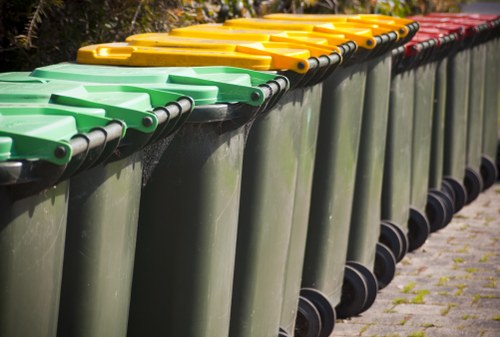 Specific responsibilities are distributed as follows:
- Senior management: define policy, allocate resources and review performance;
- Supervisors: ensure safe systems are implemented and monitored;
- Operatives and drivers: follow safe working procedures, report defects and hazards immediately.
Training, supervision and competency assurance underpin these responsibilities. We provide induction, role-specific instruction and refresher training to ensure operatives understand safe rubbish collection methods, hazardous materials awareness and vehicle safety protocols. Training records are maintained and used to identify further learning needs and to support career development within the company.
Controls, Equipment and Operational Standards
Vehicle safety is critical in a busy service area. Vehicles used for commercial waste collection undergo pre-shift inspections, routine scheduled maintenance and prompt repair of defects. Drivers follow defined procedures for loading, securing and transporting waste to reduce risks to crew and the public. Route planning is carried out to identify safe stopping points and minimise exposure to high-risk traffic situations; this reduces the likelihood of vehicle-related incidents during rubbish collection rounds.
 Safe manual handling and proper ergonomics are promoted across all tasks involving waste handling. Mechanical aids, trolley systems and team-lifting protocols are used to limit manual lifting where possible. We also implement task rotation to reduce repetitive strain and provide guidance on handling potentially contaminated or sharp items. Lock-out/tag-out measures are used during servicing of compactors and lifting equipment to prevent accidental energisation and injury.
 Personal protective equipment (PPE) is selected based on task risk assessments and is required to be worn where specified. PPE items include high-visibility clothing, puncture-resistant gloves, safety boots, eye protection and hearing protection where necessary. PPE is inspected regularly, replaced when defective and stored appropriately. Supervisors enforce PPE use and provide coaching where adjustments are needed to ensure correct fit and effectiveness.
Monitoring, audit and continuous improvement efforts ensure the policy remains effective and relevant. We set measurable objectives, monitor leading and lagging indicators and conduct regular safety audits to confirm compliance and effectiveness of controls. All incidents and near misses are investigated to identify root causes and to implement corrective actions aimed at preventing recurrence within our commercial rubbish operations.
We commit to regular review of this policy, at least annually or following significant operational changes, to ensure alignment with evolving best practice and regulatory expectations. Staff engagement is encouraged: employees are expected to report hazards, contribute to risk assessments and participate in safety discussions. A culture of open communication supports ongoing improvements and helps uphold our duty to provide safe waste services.
Conclusion: This Health & Safety Policy outlines our approach to managing risks associated with commercial waste and rubbish collection across the Norwood service area. It is a living document that guides our daily operations and strategic decisions, reflecting our determination to deliver safe, responsible and professional waste management services.
